
In memoriam - my resolution and discipline
In which my stern resolve to write frequent and succinct pieces with a modicum of seriousness degenerates into a lengthy introspective ramble on a range of topics that deserve better.

There has long been a pattern to my writing that applies whether I’m composing a simple text message or aiming for my life’s masterwork, which is that in my head everything gravitates towards the latter regardless, and the internal standards I set myself as a consequence are so intimidating that the only time I’m ever going to have the time and energy to do myself and my reader(s) justice is sometime tomorrow. Which as everyone knows, never comes.
And then, if I somehow do wrestle myself into making a start with something, so much time has passed since the initial idea, that a hundred other connected ideas have crowded in that want to make themselves part of the word hoard.
And then, instead of just getting started on the thing I want to write about, or telling the person at the end of the text or email what it is I need them to know, I feel the need to explain myself. To make the excuses I’ve just made now, so that before I know it I’m a couple of hundred words down without having said anything worthwhile, twenty minutes of my writing hour have gone, and already the carefully built up but super-fragile ego that got me to the keyboard in the first place is shattered and the lure of doom-scrolling beckons, just a tab away.
But not this time. Of course what should happen now is that I think, ‘Okay you’ve warmed yourself up — now delete that junk and get started on the topic proper’, but as I may have already mentioned, I’m lazy and the prospect of just dumping those words that I’ve eked out so far is terrible. Maybe I could delete them later, in the editing process, but I won’t because I’ll tell myself that they are all part of the truth of my writerly self that I cannot deny, however inappropriate their tone might now seem to the subject matter I want to deal with here. I have reverted to the mildly jocular self-deprecation that has been the tone I set in the first three pieces on this substack, when what I really want to write about is death and loss, and what it means to grieve and memorialise.
When I started writing my last piece, in France, I had a narrow topic in mind and a clear thesis I wanted to explore, but promptly got derailed by the nonsense in a supermarket. I had visited one of the many Commonwealth War Graves Commission Memorials in northern France, at Arras, where my great uncle Edgar is commemorated on a huge six-bay Lutyens designed monument alongside the names of almost 35,000 other servicemen who died in that region in just a a couple of years with no known grave. I didn’t write about it at the time, but I did write a short poem back at home.
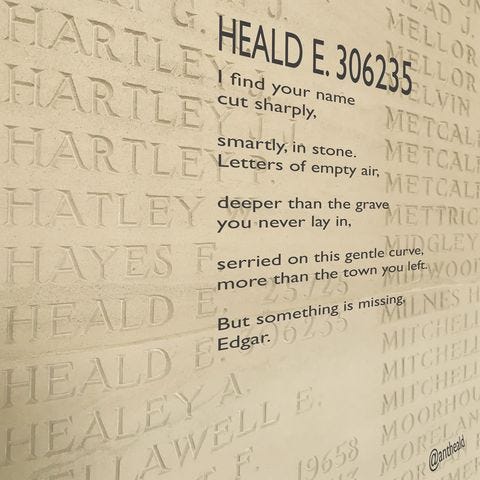
I started trying to get my thoughts into order about how even though of course great uncle Edgar was so far removed from me generationally, and I hadn’t even known his brother, my grandfather, nevertheless the blood connection gave a poignancy that was different from visiting other memorials and cemeteries that we had been to before where all those names were an undifferentiated (and sometimes overwhelming) mass. I was going to discuss the tension between the apparently natural magnetism of that blood connection and the dangers of blood and soil nationalism; of the devastating consequences, seen in 1914-18, in 1939-45, and in every single other year before, between and since, and across all parts of the world that we usually don’t notice because it’s not killing ‘people like us’, of a belief that our kinfolk, our folk, are more important, are greater, than others’.
And then the queen died, and I was plunged into the weird dissociation of watching people grieving (and others apparently feigning grief) over someone, nice woman though I’m sure she was, to whom I was pretty indifferent, and whose role I find deeply problematic. I read screeds of political analysis and personal reflection on the woman and the role and couldn’t find a clear side to be on, or much that resonated fully with the complexity of my thoughts and feelings about an event that, try as I might at times, could not be ignored (Laurie Penny’s brilliant piece for GQ on ‘the Queue’ came the closest). I saw what seems to be my main audience for this substack, my big sisters, exchanging messages that sounded weirdly formal, as if they were official statements of mourning required by an Orwellian state. I felt uncomfortable reading about ‘great pride for our late queen and country’, moments after reading harrowing personal accounts from people who weren’t talking about names on a memorial, or a bit of pomp and circumstance, but about their own personal suffering and the loss of their loved ones in British concentration camps in Kenya or in the British government fuelled horrors of the Biafra war, well into Elizabeth’s ‘reign’.
What you don’t see as you slide smoothly from that paragraph to this is the several hours in between, where I disappeared again into the welter of online articles about those conflicts and others, musing over whether I should even mention them, because, well it’s complicated, and I’m no expert, and the yah-boo social media fuelled ‘if you’re not wholly for us you must be against us’ and ‘whataboutery’ culture that we have developed makes a thin-skinned fey complacent bag of privileges like myself blanche and have to go and make a cup of tea, or listen to a discussion on procrastination, or something.
And then (where the antecedent referent of ‘then’ is prior to the point I’d reached at the end of the last paragraph) time slid on to the day I started writing this: yesterday, 26th September, the 20th anniversary of my mum’s death, and I thought ‘right, good, I can ditch all that tricky stuff and write about mum instead.’ I know I can do that. I’ve done it before, here and here and here and here. But it turned out I couldn’t quite bring myself to ditch all that tricky stuff, and nor could I write separately about mum because it was all tangled up together, and and bound up with the anxiety and family tensions surrounding my father-in-law still being in hospital over five months after his devastating stroke that has been preoccupying me daily for the past several months, and now with another thread of complication worming its way into the mental mess, as I’ve just started reading Gillian Clarke’s version of The Gododdin that I bought at the weekend that laments the fallen of the battle of Catraeth (Catterick) in Y Hen Ogledd — the Welsh speaking ‘Old North’ — that later came to be called Yorkshire, where I was born, and whose ‘folk’ I’ve always felt I belonged to. Aaand breathe…
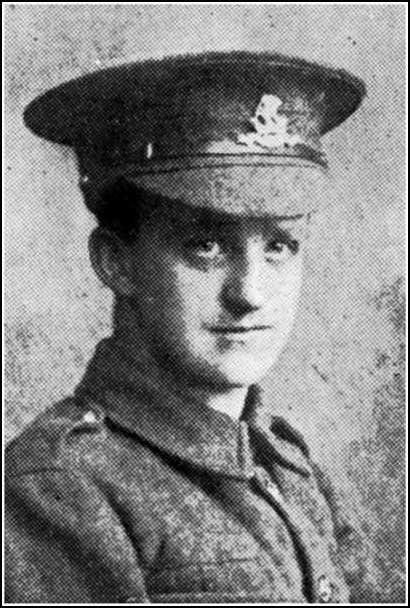
So what does it mean to memorialise the dead of WW1 (our ‘side’, of course) and be moved by the last post ceremony at Ypres, wondering if Drummer Edgar Heald had played that tune, as soldiers of that rank were also often buglers, I believe? And what does it mean to memorialise those who died cruelly at the hands of ‘our boys’ who swore allegiance to ‘our’ queen and country, enacting the policies of ‘her majesty’s government’? And what does it mean to memorialise my mum on the day I had not remembered it was my best friend’s birthday? To memorialise the dead over the living? And to memorialise the fallen of Catraeth and to draw the link from them, to Owain Glyndwr, to YesCymru and the rest of the modern Welsh nationalist movement? And is it OK to support that, or is any kind of nationalism inevitably going to be a bit Volky?
And then? I found myself running out of time yet again as another London Writers’ Hour came to an end and we were chatting together afterwards and I was talking about how I never get anything finished but some people asked me about my substack and now — who knows? — maybe even some of them might want to look at it so:
The End.
Edited to add postscript:
Since this post turned into a barely coherent dump of loosely connected ideas I may want to return to later, I wanted to add something that I made a note to revisit, but forgot while I was writing, which is that after the death of Hilary Mantel I was listening to a radio talk she did which included the sentence, “As soon as we die we enter into fiction.”
I also realise that I’m doing this Substack thing all wrong in lots of ways, not least that it seems that I should be encouraging interaction and numbers growth by including what I believe are known as ‘calls to action’. So, erm:
DO SOMETHING!
Such a relief to read about others' writerly meanderings! Thanks!
Writing through it, in it, over it. I loved reading this and going on this journey with you. Thank you for allowing yourself the space to write what was on your mind and heart, and thank you even more for sharing it with us.